


Page 46 - I have a dream
P. 46
THE ENGLISH SCHOOL MA GA ZINE 2022

              BIO-DATA                                          A simple description of the term
                                                                ‘Bio-data sonification’ is the use of
              SONIFICATION:                                     technology to turn real-time electrical
                                                                signals of living organisms (usually
              THE VOICE OF                                      plants) into sound. This project was

                                                                inspired by devices like ‘Plantwave’
              THE PLANTS                                        which, seemingly magically, produce


              By Panagiotis Filalithis 7R                       music out of any plant.
                                                                  Of course, the plants themselves do not produce music. What
                                                                goes on in plants that allows the conversion of signals into music is
                                                                electrical impulses. While plants do not have a true nervous system
                                                                like many animals, they can still generate such impulses, called
                                                                action potentials. This happens whenever the concentration of ions
                                                                (charged particles) is different between the inside and outside of a
                                                                plant cell, creating what is called an electrochemical gradient. This is
                                                                managed by specialized protein channels and pumps located in the
                                                                cell membrane of plant cells, and this process happens throughout
                                                                the plant. Unfortunately, scientists are still not quite sure about how
                                                                these electrical signals are “utilized” by most plants, but they believe
                                                                that these signals play a role in regulating physiological processes,
                                                                especially those that allow plants to respond to environmental cues
                                                                like light, touch and gravity. However, it is known that electrical
                                                                signals are involved in bringing about rapid movements in some
                                                                plants. A well-known example is the carnivorous plant, Venus
                                                                flytrap, which responds to touch by insect prey by snapping shut its
                                                                “mouth” (1).
                                                                Putting the plant biology aside, it is time to see
                                                                how we have used the naturally occurring
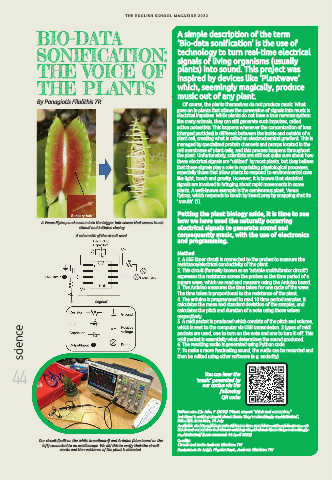
                A Venus Flytrap and a zoom into the trigger hair sensor that senses touch
                             stimuli and initiates closing.     electrical signals to generate sound and
                            A schematic of the circuit used     consequently music, with the use of electronics
                                                                and programming.

                                                                Method
                                                                1. A 555 timer circuit is connected to the probes to measure the
                                                                resistance/electrical conductivity of the plant.
                                                                2. This circuit (formally known as an ‘astable multivibrator circuit’)
                                                                expresses the resistance across the probes as the time period of a
                                                                square wave, which we read and measure using the Arduino board.
                                                                3. The Arduino measures the time taken for one cycle of the wave.
                                                                The time taken is proportional to the resistance of the plant.
                                                                4. The arduino is programmed to read 10 time period samples. It
                                   Legend
                                                                calculates the mean and standard deviation of the samples, and
                                                                calculates the pitch and duration of a note using those values
                                                                respectively.
                                                                5. A midi packet is produced which consists of the pitch and volume,
                                                                which is sent to the computer via USB transmission. 2 types of midi
         science                                                packets are used, one to turn on the note and one to turn it off. This
                                                                midi packet is essentially what determines the sound produced.
                                                                6. The resulting audio is generated using Python code.
                                                                7. To make a more fascinating sound, the audio can be recorded and
                                                                then be edited using other software (e.g. audacity).

     44                                                                ‘music’ generated by
                                                                          You can hear the

                                                                         our cactus via the
                                                                               following
                                                                                QR code:


                                                                Reference: (1): Jabr, F. (2010) ‘Plants cannot "think and remember,"
                                                                but there's nothing stupid about them: They're shockingly sophisticated’,
                                                                Scientific American, 16 July.
                                                                Available at: https://blogs.scientificamerican.com/observations/plants-cannot-
                                                                think-and-remember-but-theres-nothing-stupid-about-them-theyre-shockingly-
                                                                sophisticated/ (Last accessed: 14 April 2022)
               Our circuit (built on the white breadboard) and Arduino (blue board on the   Credits
                left) connected to an oscilloscope. We did this to verify that the circuit   Circuit and code: Andreas Nicolaou 7W
                      works and the resistance of the plant is detected.   Equipment: Dr Leigh, Physics Dept., Andreas Nicolaou 7W

